

from Cheese, Wine, and Bread
The first time I had khachapuri was at a Georgian restaurant in Paris. “There’s one reason you need to try this restaurant: their khachapuri,” my friend Natalie told me. This was before I lived in Paris for culinary school, and I was visiting her as a wide-eyed tourist. Why is she taking me to a Georgian restaurant in France? I wondered, but instead asked, “What’s catch-a-poori?”
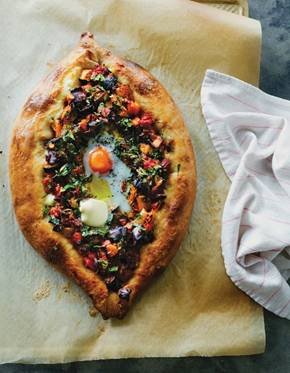
“It’s the bready-cheesy-eggy dish you will be obsessed with.” My friends know me so well. Indeed, khachapuri further proves nearly every culture has a staple bread-and-cheese dish. (And egg! I’m getting Welsh rarebit vibes.) There are different versions, from different regions of Georgia. Some variations enclose the cheese-egg mixture in a flat, stuffed circle, like a gratuitously thick, enclosed cheese quesadilla, but the style I riff on here is boat-shaped, with a cheese-filled crust, and topped with a single egg.
Typically, that cheese-egg combo in the crust bubbles away in the centre of the dish, too, but since I think of Paris when I think of khachapuri, I make a French-inspired version: ratatouille khachapuri. The crust is still filled with the aforementioned cheese-egg combo, but the belly of the boat is filled with ratatouille, a Provençal vegetable stew.
When you’re cooking each part of the ratatouille, before you curse me for not having you toss all the vegetables into the pan together, let me defend myself. Follow my instructions and cook each vegetable separately, because they have different cooking times, and season with salt and pepper each time you add a new vegetable to the pan. You’ll end up with an exceptional ratatouille instead of a decent yet mushy one.
Georgians top just-baked khachapuri with butter, which is yet another reason this dish brings me back to Paris. Finishing a dish with a dollop of butter is very French to me, as monter au beurre was the culinary school direction to complete sauces, soups – just about everything.
Ingredients
Dough:
1 cup (230 grams) full-fat plain yogurt
1 tablespoon neutral oil (preferably sunflower oil)
1⁄2 teaspoon fine sea salt
1 teaspoon unsalted butter, melted
2 cups (260 grams) all-purpose flour 1⁄2 teaspoon baking powder
1 red or yellow bell pepper, cut into 1⁄2-inch (1-centimeter) cubes
1 garlic clove, peeled
1 beefsteak tomato, cut into 1⁄2-inch (1-centimeter) pieces
2 tablespoons chopped fresh parsley
Ratatouille Filling:
Extra-virgin olive oil, for sautéing
1 medium eggplant, cut into 1-inch(2-centimeter) cubes
Kosher salt and freshly ground black pepper
1⁄2 large zucchini, quartered lengthwise, then cut crosswise into 1⁄4-in/1 cm-thick
slices
1 yellow onion, thinly sliced
Cheese Filling:
2 cups (230 grams) shredded and/or crumbled cheese (a combination of equal parts shredded mozzarella, queso fresco, and feta cheese)
4 tablespoons (1⁄2 stick/60 grams) unsalted butter, melted
1 egg
To Finish:
2 eggs
1 tablespoon unsalted butter
A few fresh basil leaves, chopped
Directions
Make the dough: Mix the yogurt, oil, salt, and melted butter in a small bowl. Mix the flour and baking powder in a large bowl, then gradually add the yogurt mixture, stirring as you pour. Form the dough into a ball, cover the bowl with a clean kitchen towel, and let sit in a warm place for 1 hour.
While the dough rests, start the ratatouille: Pour about 2 tablespoons of olive oil into a large skillet over medium heat and add the eggplant cubes. Season with salt and black pepper and stir. Cook, stirring occasionally, for 8 to 10 minutes, until the eggplant cubes are cooked through and slightly golden. Transfer the eggplant to a large plate to cool.
Add 1 tablespoon of olive oil and the zucchini to the pan, still over medium heat. Season with salt and black pepper and stir. Continue to stir occasionally as the zucchini cooks, 5 to 6 minutes, until softened and golden. Transfer the zucchini to the plate with the eggplant to cool.
Add 1 tablespoon of olive oil and the onion to the pan, still over medium heat. Season with salt and black pepper and stir. Cook until the onion is translucent, 3 to 5 minutes, then stir in the bell pepper, garlic, and a pinch each of salt and black pepper. Cook
for 1 minute, then stir in the tomato. Taste and season with more salt, if desired. Add the parsley, give one last stir, and remove the pan from the heat. Let cool, then remove the garlic clove and transfer the mixture to a medium bowl. Add the zucchini and eggplant and gently toss to combine the vegetables.
Make the cheese filling: Mix the cheeses, melted butter, and egg in a bowl until well combined. Set aside.
Place the dough on a lightly floured work surface and knead for a few minutes, until it’s a smooth ball. Cover with a clean kitchen towel and let sit for 10 minutes.
Preheat the oven to 450°F (230°C). Line a sheet pan with parchment paper.
Lightly flour the work surface and place the ball of dough in the center. Using a rolling pin, roll the dough into a 12-inch (30-centimeter) circle. Transfer the dough to the prepared sheet pan. Spoon the cheese filling evenly in two curved lines along the top and bottom edges of the dough, leaving a border of 2 inches (5 centimeters) on the left and right sides. All along the top and bottom edges, roll the dough over the cheese mixture and seal it (a bit like a stuffed-crust pizza). Pinch together the dough on the left and right sides to form pointed tips, making a boat shape. Fill the center of the boat with the ratatouille mixture.
Lightly beat one of the eggs, then use a pastry brush to brush the exposed dough with the whisked egg. Bake the khachapuri for 15 minutes, until the crust is golden. Carefully slide the remaining raw egg onto the center of the ratatouille filling, then return the bread to the oven for 2 to 3 minutes, until the egg white is cooked but the yolk is still runny. Remove from the oven.
Place the butter on the egg. Garnish with the basil and serve immediately. In Georgia, the filled crust is traditionally ripped off and dipped in the cheesy, eggy center of the boat. With this ratatouille-filled version, I suggest cutting the khachapuri into pieces like you would an oddly shaped pizza and eating them with your hands.
Nada’s Tips & Tricks: Change up the filling making a different galette-type bread. Try asparagus, peas and chorizo for spring, goat cheese and sun-dried tomatoes for summer, ham and mustard butter for fall, and cabbage and sausage for winter. Use different cheeses to compliment the filling. The possibilities are endless!

Recipe from Cheese, Wine, and Bread: Discovering the Magic of Fermentation in England, Italy, and France by Katie Quinn © 2021. Published by HarperCollins Publishers. All rights reserved. Books – HarperCollins Canada